

* The application of the product is reserved exclusively for health care professionals with appropriate qualifications.
MEDICAL DEVICE
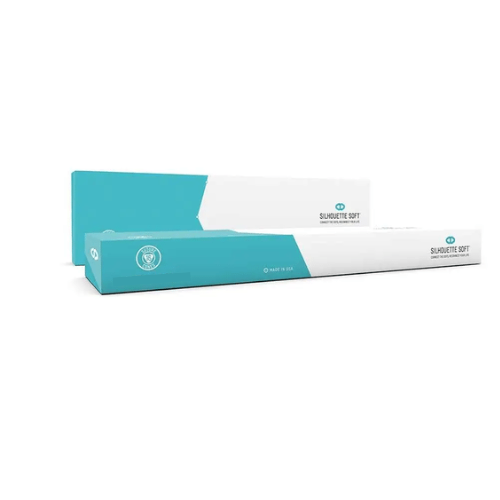
Silhouette Soft are the bidirectional sutures completely resorbable for the lifting of tissues and the regeneration of collagen in various areas of the face and body. The action of Silhouette Soft is twofold:
• Action of lifting of the tissues of the malar area and the eyebrow, reshaping of the mandibular line and the neck for a natural and immediate effect. Results are immediately visible thanks to the shaping of the area and the traction performed according to the needs and desires of the patient;
• Action of regeneration of the tissues of the treated area for a gradual and lasting result. Thanks to the gradual resorption of polylactic acid (PLA), collagen is restored to give greater definition to the features, maintaining the volume effect over time.
How It Works
The Silhouette Soft suture consists of a thread of polylactic acid of length from 30 cm to 26.8 cm depending on the type of Silhouette Soft used, on which eight cones made of L-lactic acid (Polylactic Acid and Glycolic Acid 82-18) are positioned, interspersed with knots.
The cones are arranged in two series oriented in opposite directions towards the ends of the thread, in order to achieve effective traction.
The central part of the thread, free of cones, measures 2 cm and is delimited by 2 knots equidistant from the center of the thread.
The Silhouette Soft are the only traction threads with resorbable cones.
The Treatment with Silhouette Soft.
Treatments with Silhouette Soft are performed in a medical office and are very quick, about 30 minutes. The treatment requires little anesthesia only at the entry and exit points of the suture needles.
Before proceeding with the treatment, the doctor performs the pre-treatment drawing that helps to identify the suture path on each side of the face following a specific pattern. The entry point from which both needles will be inserted and two exit points are identified, from each of which one of the two needles will be made to exit.
The Implantation of the Sutures.
After disinfecting the area to be treated, the entry hole is created with an 18G needle, provided along with the Silhouette Soft sutures. The first needle is then inserted at the entry point and is passed under the skin. The needle is inserted into the adipose tissue at a depth of about 5 mm. The needle is made to exit from the first exit point along with the suture.
By applying a slight traction of the suture, the cones are passed from the entry point. Once all the cones have been inserted, the traction phase is complete and we proceed with the implantation of the second end of the suture.
The second needle is inserted at the same entry point as the first one but in the opposite direction. The needle is made to exit from the predetermined exit point and by applying a slight traction of the suture, the cones are made to enter until the complete implantation of the suture itself.
The Compression of the Adipose Tissue.
Once all the Silhouette Soft suture has been inserted into the subcutaneous tissue, we proceed to the modeling phase of the treated area.
A slight pressure of the skin is applied and simultaneously the ends of the suture that protrude from the skin are pulled to allow the cones to adhere better to the subcutaneous tissue and maintain the compression effect.
Once the traction of the adipose tissue has been achieved, the excess suture that protrudes from the skin is cut.
The post-treatment.
The treatment generally does not involve postoperative pain, but pain relievers may be prescribed if necessary.
During the first week after treatment, the patient should not undergo: dental procedures, massages, aesthetic treatments on the face, and should avoid physical activities that involve physical contact. It is advisable to sleep in a supine position.
Implant Techniques.
The Silhouette Soft sutures can be implanted using different techniques depending on the desired result and the area to be treated.
Linear Patterns
Used for repositioning the cheekbones and for treating the neck.
Obtuse Angle Patterns
They are ideal for enhancing specific areas, for example, they provide greater definition of the mandibular line.
V Patterns and U Patterns
Allow optimal anchoring and strong traction. The V technique is indicated for treating thin skin; while the U technique is particularly indicated for thick tissues. Both patterns are mainly used in the middle third of the face.