

<
Aging is associated with changes in the molecular structure of DNA, proteins, and lipids. The accumulation of these structural changes constitutes the basis of cellular aging.Bio-Restructuring, using hyaluronic acid, amino acids, and vitamins, offers substances that only hydrate and nourish the cells of the dermal tissue, but do not improve the activity of the extracellular matrix.
WHAT IS PEPTIDYAL 115?
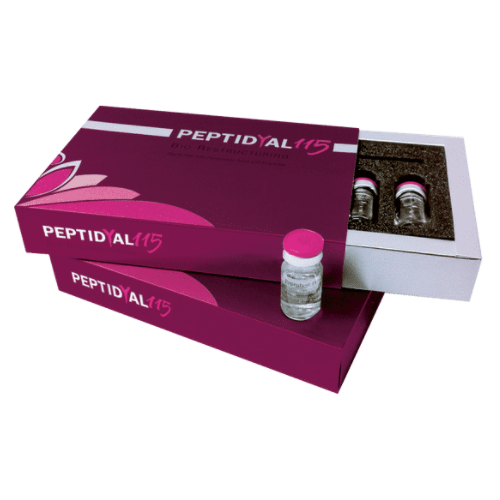
Peptidyal 115 is the result of an innovative scientific study aimed at developing a Bio-Restructuring product capable of actively supporting the physiological functional recovery of the skin, and in particular the extracellular matrix.
Peptidyal 115 can stimulate fibroblasts through the use of precursors and amino acids to produce collagen, elastin, and hyaluronic acid and slow down the catabolic metabolism with a scavenger action on oxidative stress, particularly on reactive oxygen species (ROS) and reactive nitrogen species (RNS). Furthermore, it reactivates the biological repair and regenerative processes of the tissues.
Peptidyal 115 can stimulate fibroblasts through the use of precursors and amino acids to produce collagen, elastin, and hyaluronic acid and slow down the catabolic metabolism with a scavenger action on oxidative stress, particularly on reactive oxygen species (ROS) and reactive nitrogen species (RNS). Furthermore, it reactivates the biological repair and regenerative processes of the tissues.
HOW CAN WE INTERVENE TO STOP
THE SKIN AGING PROCESS?
THE SKIN AGING PROCESS?
• Maintain the skin hydrated with substances capable of trapping water at the surface level (stratum corneum)
• Restore dermal functionality
• Increase collagen fibers and fundamental substance
• Increase the functionality of elastic fibers
• Prevent the formation of FREE RADICALS by reducing oxidative stress, which can damage both lipid structures (cell membranes) and hydrophilic structures (cytoplasm, protein structures, and DNA)
• Improve skin tone
• Diminution or disappearance of wrinkles
• Disappearance of pigmentation
• Restore dermal functionality
• Increase collagen fibers and fundamental substance
• Increase the functionality of elastic fibers
• Prevent the formation of FREE RADICALS by reducing oxidative stress, which can damage both lipid structures (cell membranes) and hydrophilic structures (cytoplasm, protein structures, and DNA)
• Improve skin tone
• Diminution or disappearance of wrinkles
• Disappearance of pigmentation
STRUCTURAL PROTEINS: COLLAGEN & ELASTIN
• Collagen is made up of polypeptide chains, called chains, that are tightly intertwined to form a compact superhelix. The primary structure of the individual chains consists of over 1400 amino acids and is characterized by the repetition of many triplets of the sequence: glycine, proline, hydroxyproline (ProHyp-Gly)n.
• Elastin is a fibrous protein composed of two subunits of polypeptides, called tropoelastin. Tropoelastin is composed of long Gly-rich helices separated by short stretches of Lys and Ala.
The two subunits are linked together by cross-linking, which provides bi- and three-dimensional elasticity.
LYSINE
Lysine is an essential amino acid (the human body cannot synthesize it, so it can only be ingested already preformed with food).
Lysine is mainly found in foods that provide animal-origin proteins. It inhibits the growth of viruses and produces L-Carnitine, which improves stress tolerance, fat metabolism, has anti-fatigue action, promotes bone growth helping the formation of collagen, the fibrous protein that makes up bones, cartilage, and other connective tissues helps the body absorb calcium.
Lysine is mainly found in foods that provide animal-origin proteins. It inhibits the growth of viruses and produces L-Carnitine, which improves stress tolerance, fat metabolism, has anti-fatigue action, promotes bone growth helping the formation of collagen, the fibrous protein that makes up bones, cartilage, and other connective tissues helps the body absorb calcium.
PROLINE
The amino acid proline is the main constituent of the stabilizing proteins of collagen and elastin. More than 10% of the elementary particles of collagen molecules consist only of proline. It is an important amino acid for the regeneration of skin and tendon structures.
The amino acid proline is a main component of the body’s structural proteins, collagen, and elastin.
A quarter to a third of the reinforcement bars in collagen, for example, are made of proline.
The amino acid proline is a main component of the body’s structural proteins, collagen, and elastin.
A quarter to a third of the reinforcement bars in collagen, for example, are made of proline.
It is a non-essential amino acid present in small amounts in the vast majority of proteins found in tendons and muscles; it constitutes about a third of the collagen structure. Glycine is necessary to build proteins in the body and for nucleic acid synthesis, the construction of RNA, DNA, and other amino acids in the body.
HYDROXYPROLINE
A heterocyclic amino acid precursor of proline, the main component of collagen. Hydroxyproline differs from proline by the presence of a hydroxyl group (OH) attached to the C (gamma) atom.
Hydroxyproline is an important component of protein collagen; together with proline, they play a fundamental role in the stability of collagen, allowing the strong twisting of the fiber helix.
Hydroxyproline is an important component of protein collagen; together with proline, they play a fundamental role in the stability of collagen, allowing the strong twisting of the fiber helix.
WHAT IS PEPTIDYAL 115?
It is useful for hydration and for the biorupture of dehydrated skin damaged by aging and sun exposure.
It is indicated for skin rejuvenation, treatment of stretch marks, and as a coadjuvant for intradermal fillers. It is part of the Restorative and Regenerative Aesthetic Medicine protocol.
It is indicated for skin rejuvenation, treatment of stretch marks, and as a coadjuvant for intradermal fillers. It is part of the Restorative and Regenerative Aesthetic Medicine protocol.